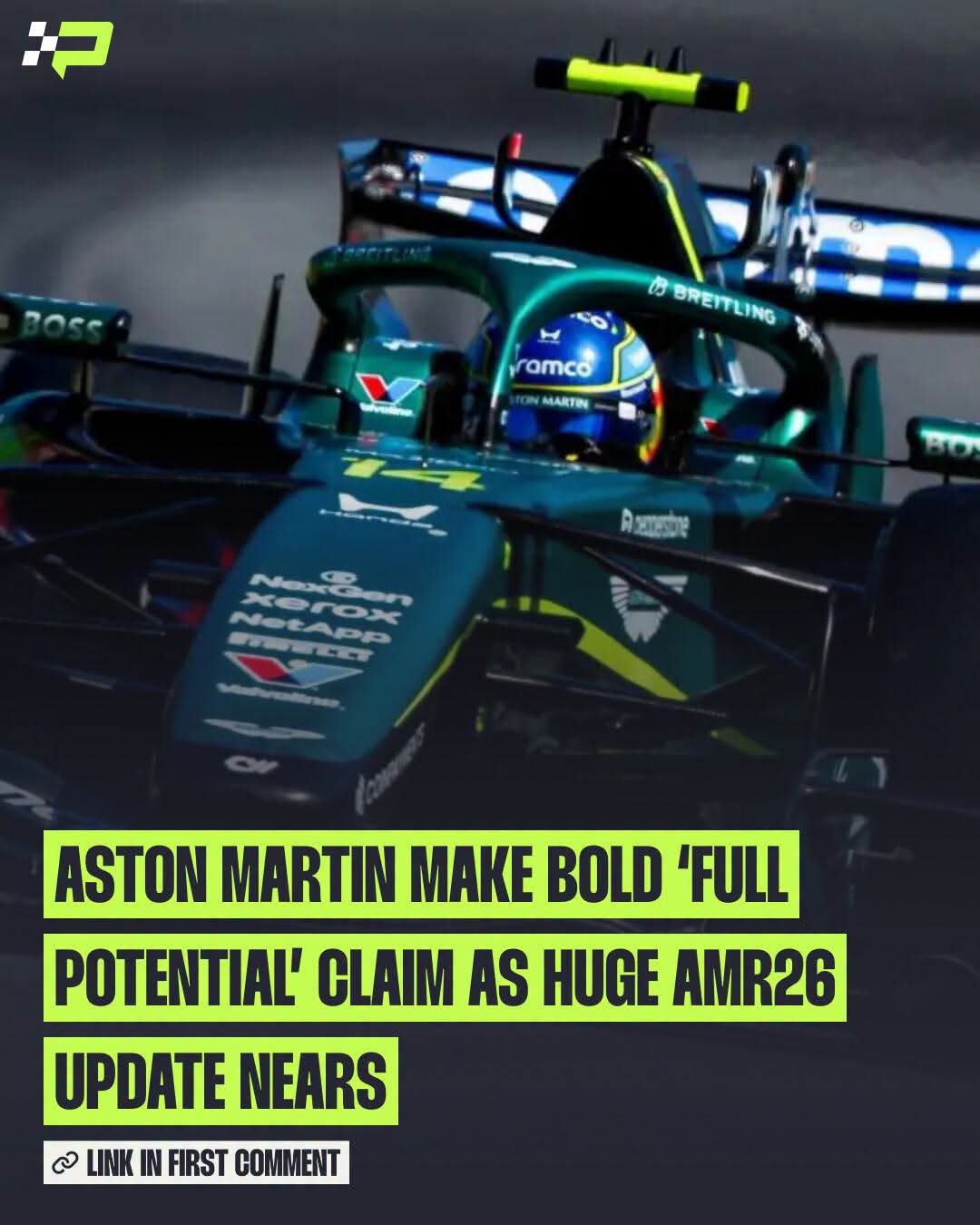
ASTON MARTIN PREPARES FOR A CRUCIAL TURNING POINT
Aston Martin believes the second half of the 2026 Formula 1 season could mark the beginning of a dramatic resurgence as the team prepares to introduce its most comprehensive upgrade package of the year. Following months of development under the guidance of legendary designer Adrian Newey, the Silverstone-based outfit is optimistic that the long-awaited improvements will unlock significantly more performance and allow Fernando Alonso and Lance Stroll to fight much closer to the midfield.
The upgrades are scheduled to debut at the Hungarian Grand Prix and represent far more than a routine aerodynamic update. Instead, Aston Martin has rebuilt several key areas of the AMR26, aiming to improve speed, consistency, weight distribution, and overall drivability. For a team that has struggled near the back of the field for much of the campaign, this package could determine whether 2026 becomes a rebuilding year or the foundation for something much bigger.
ADRIAN NEWEY’S INFLUENCE IS STARTING TO SHOW
Ever since Adrian Newey officially joined Aston Martin, expectations have risen dramatically. Widely regarded as one of Formula 1’s greatest technical minds, Newey has spent his career designing championship-winning cars for Williams, McLaren, and Red Bull. His arrival immediately signaled Lawrence Stroll’s determination to transform Aston Martin into a genuine title contender.
The Hungarian upgrade is reportedly the first major project heavily influenced by Newey’s philosophy. Rather than releasing small improvements throughout the season, Aston Martin has focused on delivering one substantial performance leap. The revised package includes a lighter chassis, redesigned aerodynamic surfaces, a new nose concept, suspension revisions, and numerous components produced in-house. This integrated approach is designed to maximize performance rather than chasing marginal gains one race at a time.
According to Newey, the changes extend beyond the race car itself. Aston Martin has modernized manufacturing processes, increased in-house production capabilities, and improved communication between research, design, and production departments. Those structural improvements may ultimately prove just as valuable as any aerodynamic development.
THE TEAM BELIEVES THE WORST IS NOW BEHIND THEM
Team ambassador Pedro de la Rosa has acknowledged that the current results have been disappointing, but he insists the upgrades should mark the beginning—not the end—of Aston Martin’s recovery. Rather than promising immediate podiums or victories, the team’s objective is to give Alonso and Stroll a car capable of consistently competing in the midfield while providing a more stable and predictable driving experience.
That realistic approach reflects the competitive nature of modern Formula 1. Closing the gap to the front-running teams requires far more than one successful upgrade. Every team continues developing throughout the season, meaning Aston Martin’s improvements must outperform the progress being made by rivals such as Alpine, Williams, Racing Bulls, Haas, and Sauber.
Still, internal confidence appears stronger than it has been for months. The organization believes years of investment in facilities, personnel, and technology are finally beginning to align.
WHY THESE UPGRADES COULD CHANGE ASTON MARTIN’S FUTURE
The significance of this development extends well beyond the remaining races of the 2026 season. Formula 1’s competitive landscape is shaped by long-term planning, and every successful development package provides valuable data that influences future car designs.
A stronger AMR26 would not only improve Aston Martin’s position in the Constructors’ Championship but also validate Newey’s technical direction ahead of future projects. Positive momentum could strengthen the team’s ability to attract elite engineers, retain experienced personnel, and convince sponsors that the ambitious Aston Martin project is progressing exactly as planned.
For Fernando Alonso, improved competitiveness would also reinforce his decision to continue racing. Despite approaching the later stages of his remarkable career, the two-time world champion remains determined to fight near the front. Giving him a genuinely competitive package could unlock performances that remind the paddock why he remains one of Formula 1’s most respected drivers.
PREDICTIONS: WHAT TO EXPECT AFTER THE HUNGARIAN GRAND PRIX
No single upgrade is likely to transform Aston Martin into an immediate race-winning force. The gap separating the leading teams from the midfield remains substantial, and development races never stand still in Formula 1. However, the evidence suggests Aston Martin is laying the groundwork for consistent progress rather than chasing quick fixes.
If the new package performs as expected, Aston Martin could begin challenging for regular points finishes during the remainder of the season. Combined with additional developments expected later in the year and the arrival of Honda’s upgraded power unit, the team may gradually emerge as one of the fastest improvers on the grid.
Perhaps more importantly, this package represents the first visible chapter of Adrian Newey’s influence. If Aston Martin delivers on its promises, the Hungarian Grand Prix may eventually be remembered as the moment the team’s long-term championship ambitions truly began to take shape.