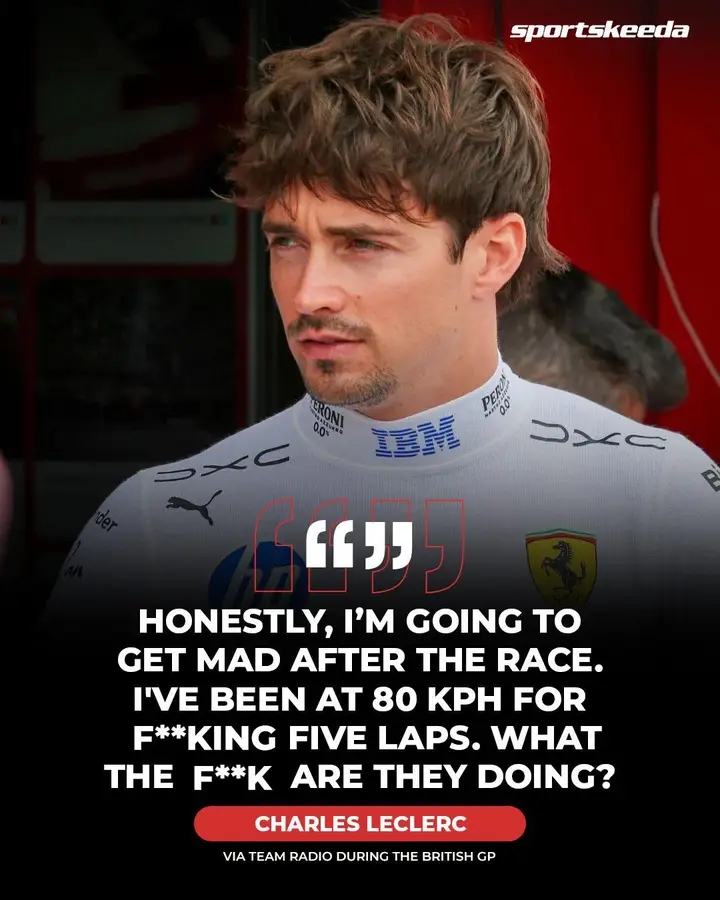
The 2026 British Grand Prix delivered plenty of drama, but one of the most revealing moments came away from the television cameras. Charles Leclerc’s frustration erupted over Ferrari’s team radio during a Safety Car period, offering fans another glimpse into the mounting pressure inside the Scuderia as it fights through another challenging Formula 1 season.
While emotional radio messages have become a familiar part of modern F1, Leclerc’s comments highlighted a much deeper issue than a single race incident. They reflected the immense expectations placed on Ferrari, the difficult decisions teams must make under pressure, and the growing urgency to maximize every opportunity in an increasingly competitive championship.
LECLERC’S EMOTIONS SPILL OVER DURING SAFETY CAR
The British Grand Prix featured changing weather, multiple incidents, and strategic uncertainty that forced every team to make split-second decisions. During one of the Safety Car periods, Leclerc voiced his frustration over the radio after questioning the team’s handling of the situation.
For drivers, Safety Car periods are often among the most stressful moments of a race. Tire temperatures drop, strategy windows change instantly, and every second can determine whether a driver gains or loses valuable positions once racing resumes.
Leclerc’s reaction showed just how intensely he was fighting to keep Ferrari in contention.
WHY FERRARI FACES CONSTANT PRESSURE
Ferrari enters every Formula 1 weekend carrying expectations unlike any other team on the grid. Every strategy call, pit stop, and setup decision is scrutinized by millions of fans worldwide.
When races become unpredictable—as they often do at Silverstone—the margin for error becomes incredibly small.
A decision that appears reasonable in real time can look completely different only a few laps later.
Leclerc’s radio frustration was likely fueled by the combination of difficult weather conditions, changing race circumstances, and the knowledge that every lost opportunity could have significant championship implications.
THE CHALLENGE OF MAKING SPLIT-SECOND DECISIONS
Formula 1 strategy is far more complicated than many fans realize.
Engineers must simultaneously monitor:
- Tire degradation
- Weather forecasts
- Safety Car timing
- Rival strategies
- Fuel targets
- Traffic
- Track evolution
All of these variables change every lap.
Drivers only see part of the picture from inside the cockpit, while engineers must process enormous amounts of live data before making crucial decisions.
That difference in perspective often creates tense radio exchanges—especially when emotions are running high.
LECLERC’S PASSION REMAINS ONE OF HIS BIGGEST STRENGTHS
Although his frustration was obvious, Leclerc’s emotional response also demonstrates one of the qualities that has made him one of Formula 1’s elite drivers.
He demands perfection—from himself and from the team.
That relentless desire to compete has helped him produce exceptional qualifying laps, memorable victories, and countless standout performances throughout his career.
However, it also means disappointing races tend to generate equally emotional reactions.
Ferrari knows that passion is part of what makes Leclerc such a valuable asset.
WHAT THIS MEANS FOR FERRARI’S CHAMPIONSHIP HOPES
Every point matters in an ultra-competitive Formula 1 season.
Ferrari cannot afford operational mistakes if it hopes to challenge consistently against rivals such as McLaren, Mercedes, and Red Bull.
Radio frustrations alone will not define Ferrari’s season, but they often reveal the internal pressure facing a team determined to return to championship-winning form.
If Ferrari can improve its race execution while maintaining strong qualifying pace, it remains capable of fighting near the front on a regular basis.
SILVERSTONE HIGHLIGHTED HOW QUICKLY RACES CAN CHANGE
The British Grand Prix once again proved why Silverstone is considered one of Formula 1’s greatest circuits.
Variable weather, Safety Cars, strategic gambles, and constant overtaking created a race where every decision carried enormous consequences.
For Ferrari, the event demonstrated that raw speed alone is no longer enough.
Success now depends equally on flawless communication, quick decision-making, and adapting instantly to changing conditions.
CAN FERRARI TURN FRUSTRATION INTO PROGRESS?
One positive for Ferrari is that emotional radio exchanges often lead to valuable post-race analysis.
The team will carefully review every strategic decision alongside Leclerc to understand what could have been done differently.
Formula 1’s top organizations rarely ignore these moments. Instead, they use them to strengthen communication and improve future race execution.
If Ferrari can learn from Silverstone, the frustration experienced during the British Grand Prix may ultimately become a stepping stone toward stronger performances later in the season.
THE BIGGER PICTURE
Charles Leclerc’s emotional radio message was about far more than one Safety Car period. It reflected the relentless intensity of modern Formula 1, where championships can hinge on a single strategic call and where every missed opportunity feels magnified.
For Ferrari, the challenge remains clear: convert competitive pace into consistent race-day execution. If the team can reduce costly mistakes and capitalize on every strategic opportunity, Leclerc has the talent to remain a major contender throughout the remainder of the season.
As the championship battle continues, moments like the one heard over Ferrari’s radio at Silverstone serve as a reminder that Formula 1 is as much a mental and strategic contest as it is a test of outright speed. Every conversation, every decision, and every lap could shape the outcome of one of the most fiercely contested seasons in recent memory.