Lando Norris endured another frustrating weekend at the Austrian Grand Prix, and fresh GPS analysis has now revealed exactly where McLaren lost crucial performance against its Formula 1 rivals. While Mercedes celebrated another dominant victory through George Russell, the data paints a worrying picture for McLaren ahead of the British Grand Prix, exposing a straight-line speed deficit that cost Norris valuable time on virtually every lap around the Red Bull Ring.
The findings arrive at a critical point in the 2026 season. McLaren entered the year hoping to build on its championship-winning campaigns from 2024 and 2025, but after eight rounds, the team remains third in the Constructors’ Championship with 159 points, trailing Mercedes by a significant margin. If the Woking outfit hopes to rejoin the title fight, solving this weakness has become an urgent priority.
MERCEDES CONTINUES TO SET THE PACE
The Austrian Grand Prix reinforced Mercedes’ dominance under Formula 1’s new regulations.
George Russell converted pole position into victory after managing both tyre wear and race pace superbly, finishing ahead of Max Verstappen and championship leader Andrea Kimi Antonelli. The result reduced Russell’s championship deficit while extending Mercedes’ advantage at the top of the Constructors’ standings.
Current standings after Austria show:
Constructors’ Championship
Mercedes – 302 points
Ferrari – 204 points
McLaren – 159 points
Drivers’ Championship
Andrea Kimi Antonelli – 171 points
George Russell – 131 points
Lewis Hamilton – 125 points
Meanwhile, Norris crossed the finish line in seventh place, more than 30 seconds behind the race winner, highlighting just how far McLaren currently sits from the front-running pace.
GPS DATA IDENTIFIES MCLAREN’S BIGGEST PROBLEM
While McLaren has often been praised for its cornering ability in recent seasons, Austria highlighted a completely different issue.
Detailed GPS analysis showed Norris losing nearly four-tenths of a second to Russell during qualifying, with roughly half of that deficit occurring on the straights alone.
The biggest difference came on the approach to Turn 4, where Mercedes consistently held a speed advantage of approximately 5 mph over the McLaren.
Around a circuit like the Red Bull Ring—where long acceleration zones dominate lap time—that disadvantage proved extremely costly.
Every lap, Norris found himself losing time before even reaching the braking zones, making overtaking and defending significantly more difficult.
WHY THE MCLAREN IS LOSING STRAIGHT-LINE SPEED
Several technical factors appear to be contributing to McLaren’s struggles.
Engineers believe the MCL40 is carrying excessive aerodynamic drag, reducing its maximum speed despite maintaining competitive cornering performance. In addition, the team’s energy deployment system is reportedly not extracting maximum efficiency compared to rivals, while gear ratio choices may also be limiting acceleration on longer straights.
Adjusting gear ratios may sound straightforward, but Formula 1 development rarely works that simply.
Changing transmission characteristics involves extensive engineering validation, simulator work, and performance modeling. Given Formula 1’s cost cap restrictions, McLaren must carefully evaluate whether the potential gains justify the resources required.
TRACK POSITION MADE NORRIS’ RACE EVEN MORE DIFFICULT
The technical shortcomings weren’t Norris’ only problem.
He also lost positions during the opening lap before strategy complicated matters further. McLaren prioritized Oscar Piastri’s pit stop to protect track position against Racing Bulls driver Isack Hadjar, leaving Norris to stop later and lose additional ground.
By the time the pit cycle concluded, the race had effectively slipped away.
With overtaking proving difficult despite multiple DRS zones, Norris spent much of the afternoon trying to recover lost positions rather than challenging the leaders.
The result was another disappointing finish that failed to reflect the team’s ambitions entering the season.
NORRIS BELIEVES MCLAREN IS FINALLY CATCHING UP
Despite another difficult weekend, Norris remains optimistic.
Earlier this season, the British driver admitted McLaren’s championship battles over the previous two years forced the team to divide its attention between fighting for titles and developing the radically different 2026 car.
According to Norris, that balancing act effectively delayed development by nearly two months.
However, he now believes the team is beginning to recover that lost ground.
Following the Austrian Grand Prix, Norris acknowledged that race circumstances—including the opening lap and pit strategy—made life difficult, but he avoided placing blame solely on the car.
His confidence suggests McLaren still believes meaningful improvements are on the horizon.
SILVERSTONE PROVIDES AN IMMEDIATE TEST
Fortunately for McLaren, there is little time to dwell on Austria.
The Formula 1 calendar now moves directly to Silverstone for the British Grand Prix, one of the team’s home races and one of the fastest circuits on the calendar.
Silverstone presents a unique challenge.
Unlike Austria, outright straight-line speed is only part of the equation. High-speed corners such as Copse, Maggotts, and Becketts reward aerodynamic efficiency and chassis balance just as much as engine performance.
If McLaren’s engineers can minimize their drag disadvantage while maintaining their cornering strengths, Silverstone could offer a far more competitive weekend.
TITLE HOPES DEPEND ON SOLVING THIS WEAKNESS
The 2026 championship is far from over, but the gap continues to grow.
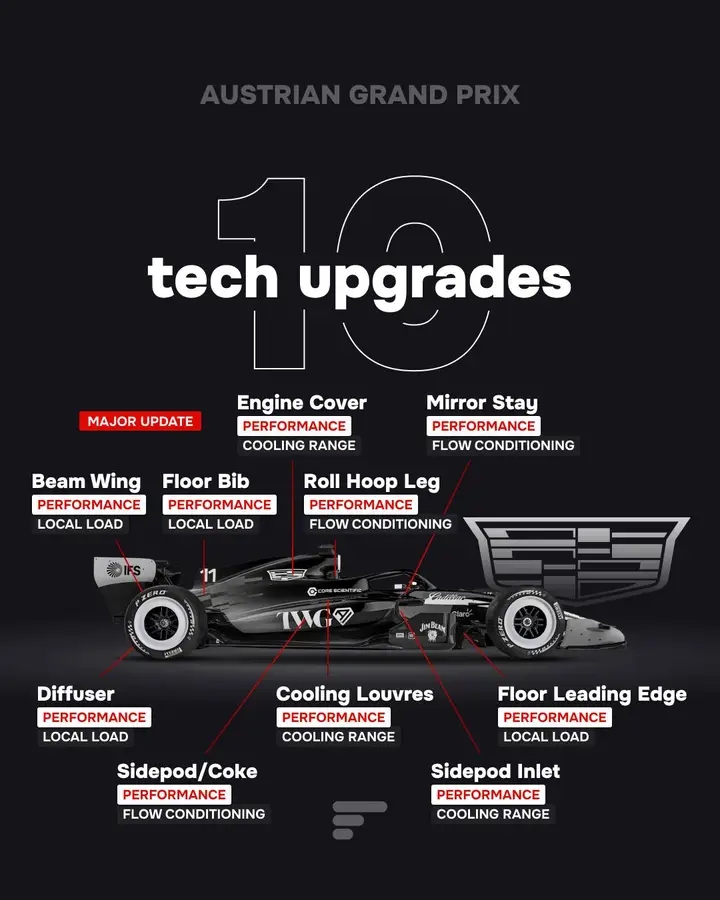
Mercedes has demonstrated remarkable consistency, Ferrari remains firmly in contention, and Red Bull appears to be recovering after introducing major upgrades in Austria.
McLaren cannot afford many more weekends where its drivers are losing significant time before reaching the braking zone.
The encouraging news is that engineers now appear to have identified the problem clearly. The difficult part will be finding a solution quickly enough to keep the team’s championship aspirations alive.
With Silverstone marking the next chapter of the season, all eyes will be on whether McLaren can translate its understanding into genuine performance gains—or whether its straight-line weakness will once again leave Norris fighting an uphill battle.