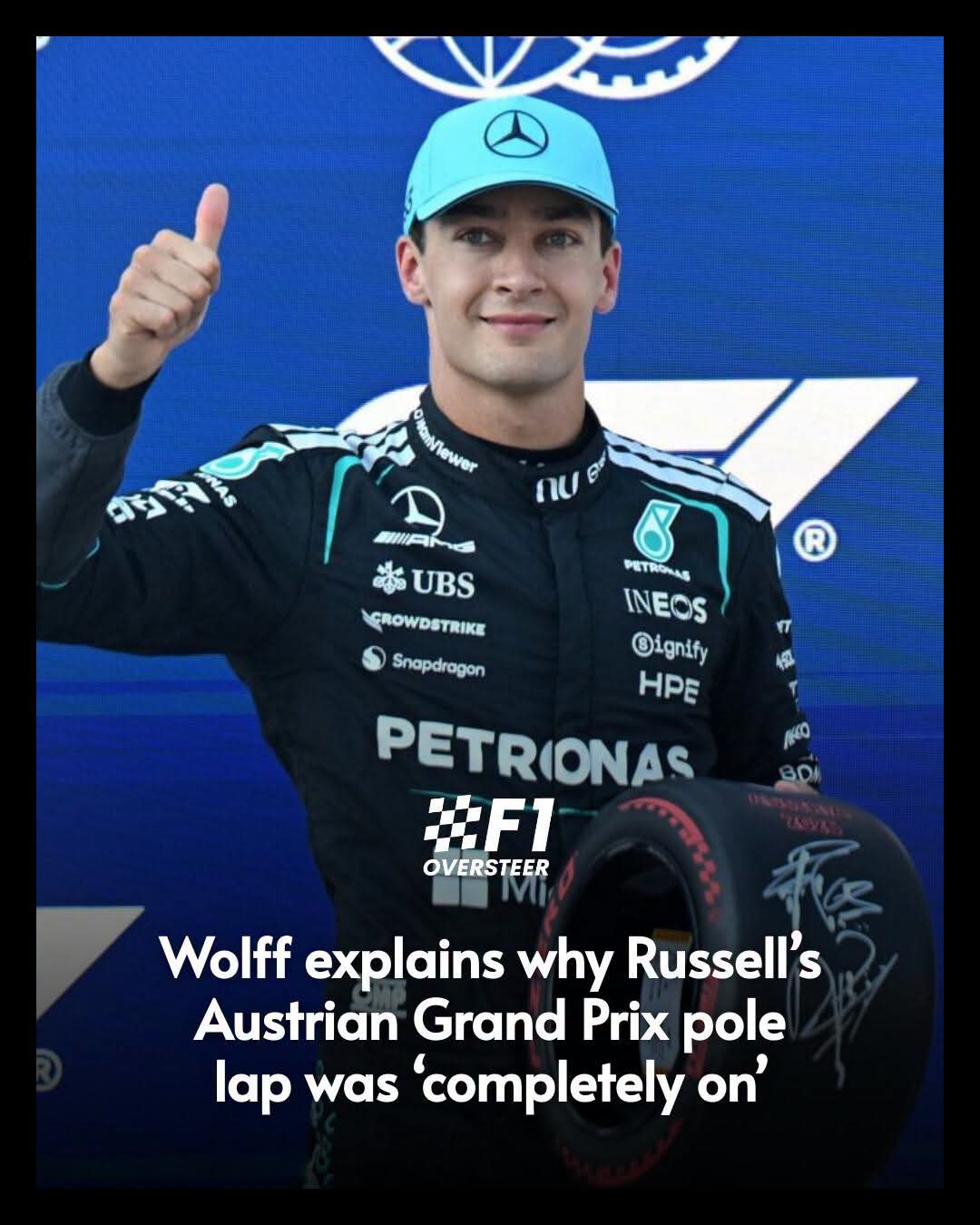
George Russell will start the 2026 Austrian Grand Prix from pole position after surviving one of the most controversial qualifying moments of the Formula 1 season. With Max Verstappen crashing in the closing seconds of Q3 and yellow flags appearing around the Red Bull Ring, many expected Russell’s sensational lap to be deleted. Instead, the FIA cleared the Mercedes driver, allowing him to keep pole after determining he had complied with the regulations.
The decision immediately divided fans, rivals, and commentators. Some argued Russell should never have been allowed to improve his lap while passing an incident zone, while others pointed to the FIA’s rulebook, which distinguishes between single and double yellow flags. Mercedes team principal Toto Wolff has now explained why he believes the officials reached the correct verdict.
CHAOTIC END TO QUALIFYING SPARKED IMMEDIATE CONTROVERSY
Qualifying appeared destined to end with Charles Leclerc on provisional pole until Verstappen lost control of his Red Bull during his final flying lap. The reigning world champion crashed heavily into the barriers, bringing out yellow flags at one of the circuit’s fastest corners.
Russell was still on a flying lap as he approached the incident. Despite the caution, he managed to complete an exceptional final sector and snatched pole position from Leclerc by more than two tenths of a second. Moments later, the FIA noted the Mercedes driver for a potential yellow flag infringement, leaving uncertainty over the final qualifying order.
As fans waited for the stewards’ decision, speculation intensified across the paddock, with many believing the lap could be deleted.
WOLFF INSISTS RUSSELL FOLLOWED THE RULES
Mercedes boss Toto Wolff quickly defended his driver after qualifying, insisting the telemetry clearly demonstrated Russell had obeyed the regulations.
According to Wolff, Russell encountered only a single yellow flag rather than a double yellow. Under FIA sporting regulations, drivers facing a single yellow must reduce speed and be prepared to change direction if necessary. They are not automatically required to abandon the lap.
Wolff explained that Russell made a substantial lift off the throttle—approximately 100 meters before the corner—costing valuable lap time before accelerating again once he had safely passed the danger area. Comparing the data with Russell’s previous laps, Mercedes argued the reduction in speed was obvious enough to satisfy the stewards.
The FIA evidently agreed, deciding there was no reason to investigate further.
WHY ANTONELLI ABORTED HIS LAP
One reason the incident generated so much confusion was the contrasting reaction of Russell’s teammate, Andrea Kimi Antonelli.
The championship leader abandoned his final qualifying attempt after believing he had encountered double yellow flags. Antonelli later admitted he mistakenly thought the situation required him to stop pushing immediately, a decision that likely cost him a front-row starting position.
Wolff suggested Antonelli simply misunderstood the signal, believing it was more severe than it actually was. The young Italian later acknowledged the mistake but also argued that incidents occurring in such high-speed corners deserve an automatic double yellow in future, calling for the FIA to review the procedure.
His comments could reignite debate over whether Formula 1’s current yellow flag system provides enough consistency during qualifying sessions.
WHY THE FIA LET THE LAP STAND
The FIA’s decision ultimately came down to one crucial detail: Russell passed a single yellow flag, not a double yellow.
Under the sporting regulations, a driver facing a single yellow must demonstrate a clear reduction in speed within the relevant marshal sector. Telemetry reportedly showed Russell lifting significantly before Turn 9, satisfying that requirement.
Had double yellow flags been displayed before Russell entered the sector, the situation would have been very different. Drivers are then expected to reduce speed substantially and be prepared to stop, making it virtually impossible to set a competitive lap. In many cases, any improved lap under double yellows is deleted automatically.
Because the evidence indicated Russell encountered only a single yellow, the FIA concluded his lap remained legal.
WHAT THIS MEANS FOR THE CHAMPIONSHIP
Keeping pole position could have enormous implications for both the Drivers’ and Constructors’ Championships.
Mercedes already leads the constructors’ standings, while Antonelli tops the drivers’ table ahead of Lewis Hamilton and Russell. Starting from pole gives Russell a valuable opportunity to reduce the gap to his teammate while strengthening Mercedes’ position against Ferrari and McLaren.
Ferrari will also see an opportunity. Leclerc starts alongside Russell, with Hamilton directly behind, creating the possibility of applying pressure from the opening corner if the Mercedes driver struggles off the line.
Meanwhile, Verstappen faces another difficult recovery after his qualifying crash. Although Red Bull has shown impressive race pace at times this season, fighting back through the field at Spielberg is never guaranteed, particularly against evenly matched front-running teams.
A DECISION THAT WILL CONTINUE TO DIVIDE OPINION
Although the FIA has officially closed the case, the debate surrounding Russell’s pole lap is unlikely to disappear anytime soon.
Mercedes maintains that the regulations were followed precisely and that Russell sacrificed enough speed to comply with the yellow flag requirements. Critics, however, argue that allowing any driver to improve their lap while passing an active incident undermines the spirit of the safety rules, especially at high-speed sections of the circuit.
The controversy may also encourage the FIA to examine whether yellow flag procedures should be tightened, particularly when crashes occur in fast corners where visibility and reaction time become even more critical.
For now, though, George Russell remains the official pole sitter, and Sunday’s Austrian Grand Prix promises to begin with even greater tension as rivals attempt to challenge both his pace and the decision that kept him at the front of the grid.