MotoGP has been rocked by one of the most controversial disciplinary decisions in recent memory after championship leader Marco Bezzecchi received a race ban following an incident involving a track marshal during the Czech Grand Prix weekend.
In a season already packed with title drama, crashes, and fierce rivalries, few expected the championship battle to take a turn away from the racetrack. Yet a moment of frustration after a sprint race crash has now become one of the defining stories of the 2026 campaign, potentially altering the trajectory of the title fight.
The punishment is significant, the timing is brutal, and the consequences could stretch far beyond a single race weekend.
THE INCIDENT THAT SPARKED A MAJOR CONTROVERSY
The drama unfolded during the sprint race at Brno when Bezzecchi crashed out while battling near the front of the field.
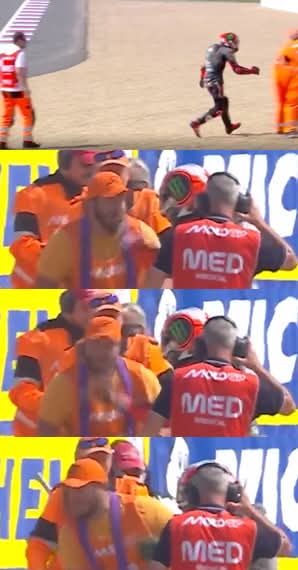
Visibly frustrated after seeing valuable championship points disappear, the Aprilia rider approached marshals who were assisting with the recovery of his motorcycle. Footage of the incident quickly spread across social media, triggering widespread debate among fans, analysts, and former riders.
Race officials reviewed the situation and determined that Bezzecchi’s actions constituted unsporting conduct serious enough to warrant disciplinary action.
The result was one of the harshest penalties seen in MotoGP in recent years: suspension from the Czech Grand Prix.
WHY MOTOGP TOOK SUCH A HARD LINE
Marshals are among the most important people in motorsport.
While riders and teams receive the spotlight, marshals work in dangerous conditions throughout race weekends to ensure events can be conducted safely. They often place themselves in harm’s way to protect competitors and clear incidents from the circuit.
Because of that, governing bodies traditionally enforce strict standards regarding interactions with race officials.
MotoGP organizers likely viewed the incident as one that required a strong response, not only to punish the action itself but also to protect the integrity of the championship and reinforce expectations regarding conduct.
From a regulatory perspective, allowing physical confrontations with officials to go lightly punished would set a dangerous precedent.
A CHAMPIONSHIP TURNING POINT?
The biggest story may not be the punishment itself but what it means for the title race.
Bezzecchi entered the weekend leading the championship and looking increasingly comfortable in the role of title favorite. However, the combination of a sprint race crash and a race ban suddenly places that advantage under serious threat.
Championships are often decided by momentum as much as outright speed.
One missed race can dramatically change the standings, particularly in a season where multiple riders remain mathematically capable of mounting a title challenge.
Rivals who may have viewed Bezzecchi as untouchable now have a golden opportunity to close the gap and inject fresh uncertainty into the championship battle.
APRILIA FACES AN UNEXPECTED TEST
For Aprilia, the incident creates a challenge that extends beyond points.
The Italian manufacturer has worked tirelessly to establish itself as a genuine championship contender against powerhouse rivals. Much of that success has been built around stability, consistency, and the leadership provided by Bezzecchi.
Now the team must manage both the sporting consequences and the public relations fallout from the incident.
Championship-winning organizations are often defined by how they respond to adversity. Aprilia’s ability to keep focus and prevent the controversy from affecting future performances may prove critical over the second half of the season.
WHAT MOTORSPORT CAN LEARN FROM THE INCIDENT
Incidents like this serve as reminders of the emotional intensity that exists at the highest levels of racing.
Elite competitors dedicate their lives to winning. When races unravel unexpectedly, emotions can sometimes spill over. However, motorsport’s history consistently shows that the greatest champions are those capable of maintaining composure under pressure.
Whether in Formula 1, MotoGP, IndyCar, or endurance racing, self-control remains one of the most valuable skills an athlete can possess.
The Brno controversy highlights how quickly a single emotional moment can overshadow months of hard work and success.
WHAT HAPPENS NEXT?
The key question now is how Bezzecchi responds.
Championship campaigns are rarely smooth. Almost every title winner faces a moment where adversity threatens to derail their season. The difference between champions and contenders is often measured by how they recover.
If Bezzecchi returns stronger, scores heavily in the races ahead, and ultimately secures the championship, this episode may be remembered as a temporary setback.
If the title slips away by a narrow margin, however, the Czech Grand Prix weekend could be remembered as the moment everything changed.
For MotoGP, the incident has already become one of the defining controversies of 2026. For Bezzecchi, it now represents the biggest challenge of his championship campaign—and perhaps the most important test of his career.